Skip to content
All projects

Django project

Vanguard Synapp

Turns simulation results into ASME and ACI engineering verifications and PDF reports: 15+ verification types and 620+ parameters in seconds.

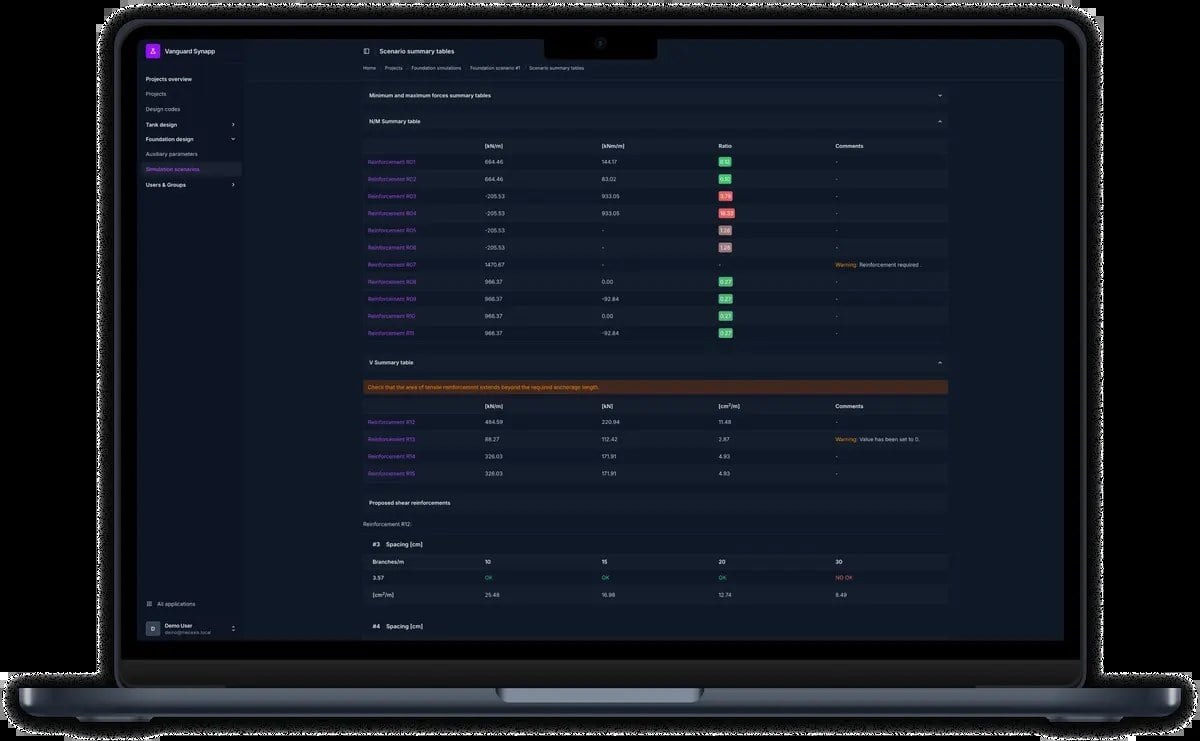
Vanguard Synapp screenshot

About Vanguard Synapp

Vanguard Synapp is the engineering verification platform that Mecexis builds for Vanguard FSI, a design and simulation firm near Barcelona that works on equipment under extreme conditions, such as molten salt tanks for concentrated solar power plants. Before Synapp, each verification was calculated in spreadsheets and each report was written by hand.

Engineers now upload their simulation results into a scenario, set the parameters once and get every verification required by the design code, each checked against its acceptance criteria. It covers pressure equipment under ASME, with its variants and national annexes, and reinforced concrete foundations under ACI, showing the formula and substituted values for each check. It automates more than 15 verification types and more than 620 parameters in seconds, and generates a complete PDF report with tables, charts and detailed calculations in one click.

Materials and code parameters are managed as configuration, not code, and calculations run in the background with change history for every scenario. It is built with Django, Pandas, SciPy and Plotly on PostgreSQL, and is developed in continuous cycles with the Vanguard team. It is a private application, so there is no public URL.

More info at https://www.mecexis.com/en/projects/vanguard-synapp/

What to notice

Summary

This is a detailed project showcase page from Mecexis (a Barcelona-based software development agency) describing Vanguard Synapp — a custom web application built for Vanguard FSI, an engineering firm specializing in designing and verifying equipment that operates at extreme conditions (high temperature, pressure, thermal cycles). The platform transforms numerical simulation results into automated regulatory compliance checks and deliverable PDF reports, replacing a manual spreadsheet-and-handwritten-report workflow. The page thoroughly documents the problem (manual, non-scalable verification processes), the solution (a centralized web app that applies design codes like ASME and ACI automatically), key features (scenario management, pressure equipment verification, foundation checks, PDF report generation, configurable codes/materials), and the continuous development methodology used by Mecexis.

Target audience

This page primarily targets **engineering firms and design/simulation consultancies** (especially those in pressure vessel design, reinforced concrete foundations, and concentrated solar power) who need to automate regulatory compliance verification from simulation data. It also speaks to **EPCs (Engineering, Procurement & Construction companies), manufacturers, and operators** who require auditable, code-compliant calculation reports. Secondarily, it targets **potential clients of Mecexis** — businesses looking for a custom software development partner who understands complex engineering domains and can build production-grade, regulatory-critical applications.

Key features

  • Simulation-to-Verification Pipeline: Upload simulation results, set parameters once, and automatically generate all regulatory verifications and PDF reports.\n- Scenario-Based Organization: Each case is a "scenario" combining a design code, verification parameters, and simulation results. Scenarios can be duplicated, updated, and tracked with change history.\n- Pressure Equipment Verification: Complete verification chain required by design codes (ASME variants, national annexes) with acceptance criteria checking.\n- Reinforced Concrete Foundation Checks: Geometry, materials, and reinforcement verification against code requirements (e.g., ACI), with displayed formulas and substituted values.\n- One-Click PDF Report Generation: Generates a complete, structured deliverable report with tables, charts, and detailed calculations ready for regulatory bodies.\n- Configurable Codes & Materials: Design codes and material parameters are managed directly in the app as configuration (not programming) — adding a material takes minutes.\n- Background Processing: Calculations and report generation run in the background while engineers continue working.\n- Differentiated Access & Audit Trail: Role-based permissions and change history for each scenario.\n- Incremental Architecture: Designed to grow by adding new materials, codes, or checks without structural changes.\n- Continuous Development Cycle: Built iteratively with a shared roadmap, deployed to production cycle-by-cycle.

Pain points

  • Manual spreadsheet calculations are unscalable: Each verification was done in spreadsheets, which becomes ineffective when complexity and volume increase (more analysis points, load cycles, multiple code snippets, revisions).\n- Hand-written reports waste expert time: Each report cost hours of expert work that provided no critical analysis — only transcription. Engineers' time was spent on data entry rather than judgment.\n- No traceability or version control: Spreadsheets don't keep history; two versions can diverge without notice; manual parameter changes leave no audit trail — a significant risk for documents audited by third parties.\n- Multiple coexisting design codes: The tool had to handle ASME with variants, national annexes, and ACI — each with its own parameters, material tables, and acceptance criteria.\n- Repetitive rework on revisions: Each revision required repeating the entire manual process from scratch.\n- Risk of inconsistent code combinations: Without validation, engineers could accidentally combine parameters in ways not covered by the design codes.

Usage instructions

Vanguard Synapp is a private web application built for and used by Vanguard FSI's engineering team, not a publicly available product. Engineers use it by: (1) uploading numerical simulation results into a scenario, (2) configuring the design code, parameters, materials, and acceptance criteria for that scenario, (3) running the verifications (which process in the background), and (4) generating a single comprehensive PDF report containing all verifications, tables, and calculations — ready for delivery to clients or regulatory bodies. The page's "Let's talk" CTA invites interested parties to contact Mecexis for similar custom development.