What to notice
Summary
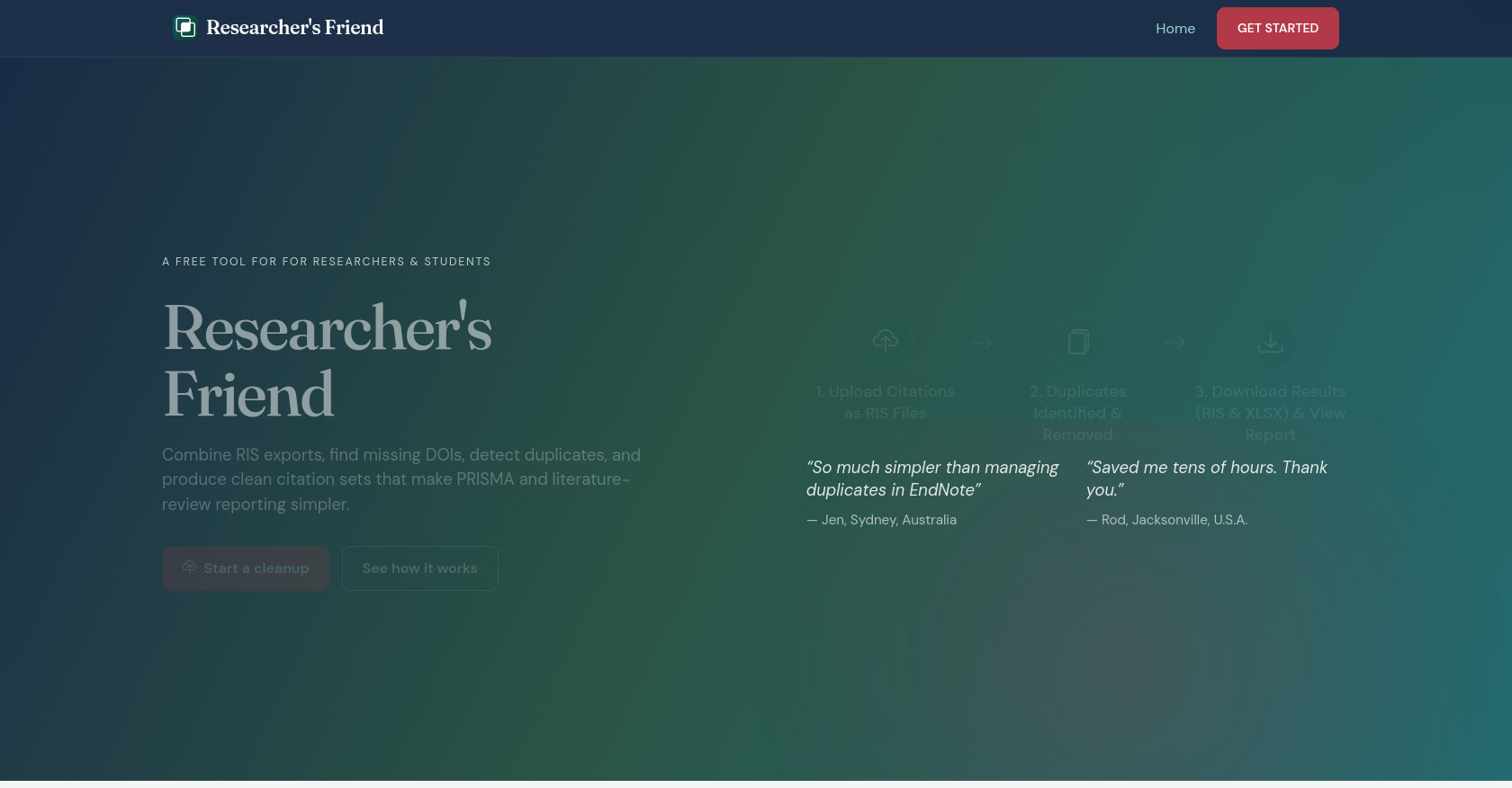
This is the landing page for Researcher's Friend (researchersfriend.org), a free web-based tool built by Dr. Gary Eckstein that automates duplicate detection and DOI lookup for literature reviews. Users upload RIS files (and PubMed .nbib) from multiple databases, the tool finds missing DOIs using local OpenAlex data, identifies and removes duplicates based on DOI matching, and provides six downloadable files (RIS and Excel formats for unique citations, duplicates removed, and unknown/unmatched citations) plus a shareable PRISMA-friendly online report. The page includes features, step-by-step instructions, testimonials, and an extensive FAQ section covering privacy, data handling, and usage instructions.
Target audience
The primary target audience is academic researchers, graduate students, and systematic review practitioners who need to merge citation exports from multiple databases (Scopus, PubMed, Web of Science, etc.) and remove duplicates for literature reviews. A secondary audience includes anyone conducting PRISMA-compliant systematic reviews who wants to simplify the citation deduplication and reporting process.
Key features
- Upload RIS files and PubMed .nbib: Supports exports from Google Scholar, EndNote, Mendeley, Zotero, Scopus, Web of Science, Cochrane, EBSCOhost, Embase, and more
- DOI Lookup & Enrichment: Finds missing DOIs using local OpenAlex Parquet snapshots with Levenshtein similarity matching at 90%
- Automatic Duplicate Detection: Uses DOI as the identifier to flag and remove duplicate citations
- Six Ready-to-Use Files: Downloads include unique citations, duplicates removed, and unknown (no DOI) records — each in both RIS and Excel formats
- PRISMA-Friendly Online Report: Every job gets a shareable URL with flow counts for reporting identification and deduplication steps
- Privacy-First Auto-Deletion: Uploads and generated files are automatically deleted after 7 days; no identifying data shared with third parties
- Free to Use: Processes up to 5 files and 50,000 citations per job at no charge
Pain points
- Manual duplicate management is slow and error-prone: Manually merging citation exports from multiple databases and identifying overlapping results is tedious and time-consuming
- PRISMA reporting complexity: Justifying duplicate removal and documenting identification steps for PRISMA flow diagrams requires meticulous record-keeping
- Incomplete metadata: Many exported citations lack DOIs, making reliable duplicate matching difficult without enrichment
- Disconnected workflows: Researchers need to combine files from EndNote, Zotero, Mendeley, Scopus, PubMed, and others — each with different formats
- Lack of transparency in deduplication: Many tools don't provide clear audit trails or separate 'unknown' records that need manual verification
Usage instructions
Users upload their RIS files (or PubMed .nbib) via the 'Get Started' or 'Start a cleanup' button on the site. The tool processes the files by combining them, looking up missing DOIs from local OpenAlex data, and identifying duplicates using DOI matching. Users then receive a link via email to download a zip file containing six files (unique citations, duplicates removed, and unknown records, each in RIS and Excel formats). A shareable online report with PRISMA-style flow counts is also generated. Files are available for 7 days before automatic deletion.