Skip to content
All projects

Django project

Quiralis

Surgical management platform for SART and Institut Roura. Google Document AI cut daily document review from 8 hours to 20 minutes per person.

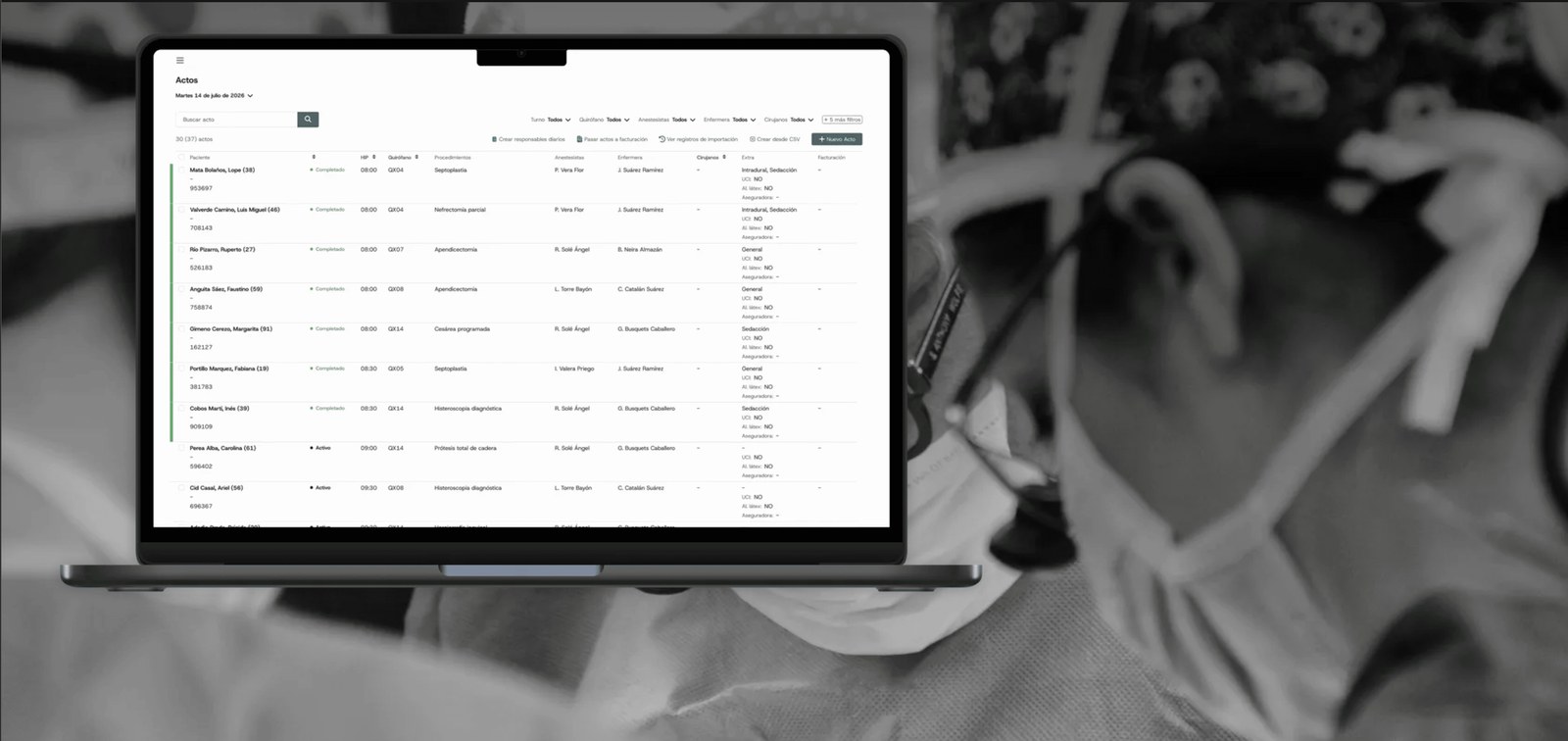
Quiralis screenshot

About Quiralis

Quiralis is the surgical management platform that SART, an anaesthesiology group, and Institut Roura, an ENT medical centre, use to run all their surgical activity. Between them, 70 to 80 doctors, nurses and administrative staff work on it every day. It replaced a proprietary system written in MUMPS in the late 1980s and a set of manual processes.

It brings together three areas. Procedure planning covers dates, operating rooms, doctors, nurses and type of anaesthesia. Insurance authorisations arrive as PDFs in more than 30 formats, and Google Cloud Document AI extracts patients, identifiers and procedures so staff only review and link them. Billing handles invoices, self-billing and credit notes, and reconciles grouped insurer payments against what was invoiced. Daily document review went from 8 hours to 20 minutes per person, a 96% reduction.

Access is role based with two-factor authentication, every download and export is recorded in an immutable, cryptographically chained audit log, and files are stored encrypted. It is built with Django, HTMX and Alpine.js on PostgreSQL and Docker, and installs as a PWA. It is a private application, so there is no public URL.

More info at https://www.mecexis.com/en/projects/quiralis/

What to notice

Summary

This is a detailed project case study from Mecexis, a web development agency, showcasing Quiralis — a custom-built, end-to-end surgical management platform developed for SART (an anesthesiology group) and Institut Roura (a medical center). It integrates medical procedure planning, AI-powered insurance authorization processing (via Google Cloud Document AI, handling 30+ PDF formats), and automated billing/payment reconciliation into a single Django-based system. The page describes the clients' history, the pain points of legacy systems (a MUMPS-based system from the 1980s and manual processes), the phased migration strategy, measurable outcomes (96% reduction in daily review time from 8 hours to 20 minutes), and the architecture (Django, PostgreSQL, Docker, Alpine.js, HTMX, PWA support). It positions Mecexis as the development partner and ends with a call-to-action and client logos.

Target audience

The primary target audience is **surgical centers, clinics, and medical groups** (especially in private healthcare) that need to digitize and streamline their end-to-end surgical management — from procedure planning and insurance authorizations to billing and payment reconciliation. It also targets **healthcare administrators and decision-makers** dealing with legacy systems (outdated software or fully manual processes) who need a modern, AI-enhanced replacement without disrupting ongoing patient care. Secondary audiences include **potential clients of Mecexis** (the development agency) evaluating their expertise in Django, AI integration, and healthcare-specific custom software development.

Key features

  • Medical Procedure Management: Central module for planning procedures with dates, times, operating rooms, anesthesia type, physician/nurse assignments; controlled stages from draft to completion; bulk import from external files; physician access to daily assignments.
  • Documentary AI for Authorizations: Bulk import of insurance PDFs; automatic extraction of patients, identifiers, and procedures using Google Cloud Document AI across 30+ company formats; human review and correction workflow keeps people in control.
  • Billing & Payment Reconciliation: Auto-populated billing documents (invoices, self-billing proformas, credit notes); payment matching against grouped mutual insurance payments; discrepancy handling and automatic credit note generation.
  • Security & Compliance: Role-based access (medical, nursing, administrative, management); two-factor authentication for sensitive profiles; immutable audit trail with cryptographic chaining; encrypted file storage with automated external backups.
  • Technology Stack: Built with Django + PostgreSQL; Dockerized infrastructure; Alpine.js and HTMX frontend; Mecexis proprietary management screen system; installable as a PWA on any device.
  • Phased Migration: Coexistence with legacy systems during transition; production validation per module; constant communication with medical/administrative teams.
  • Scalable Architecture: Sector-specific, product-centric design allowing new surgical centers to be added without a complete overhaul.

Pain points

  • Legacy technology risk: SART's proprietary MUMPS system from the late 80s had no generational replacement, no integration possibilities, and was unsuitable for current security and traceability requirements.
  • Manual administrative burden: Institut Roura relied entirely on manual processes for planning and administration, requiring full days of effort.
  • Insurance authorization fragmentation: Authorizations arrive as PDFs in over 30 different formats (one per insurance company), requiring extensive manual review to extract patients, identifiers, and procedures.
  • Complex payment reconciliation: Mutual insurance companies pay for transfers grouping hundreds of services; reconciling collected vs. billed amounts is manual, slow, and error-prone.
  • No interruption allowed: The system needed to be replaced without stopping ongoing patient care or operating room activity.
  • Generic software failure risk: A generic off-the-shelf system would not accommodate the specific daily operations of these surgical centers.

Usage instructions

Quiralis is a custom-built platform developed by Mecexis specifically for SART and Institut Roura. It is not a publicly available SaaS product. Usage involves: 1) Medical staff accessing the platform (also installable as a PWA on any device) to view daily procedure assignments and responsibilities. 2) Administrative teams using the platform to import insurance authorization PDFs in bulk, review/validate AI-extracted data (patients, identifiers, procedures via Google Cloud Document AI), link authorizations to procedures and billing. 3) Billing teams managing invoices, self-billing proformas, credit notes, and reconciling grouped mutual insurance payments against invoiced amounts, with automatic credit note generation for discrepancies. 4) Management overseeing the entire workflow with role-based access controls and 2FA. The page serves as a case study to demonstrate Mecexis's capabilities to prospective clients considering similar custom healthcare software development.