What to notice
Summary
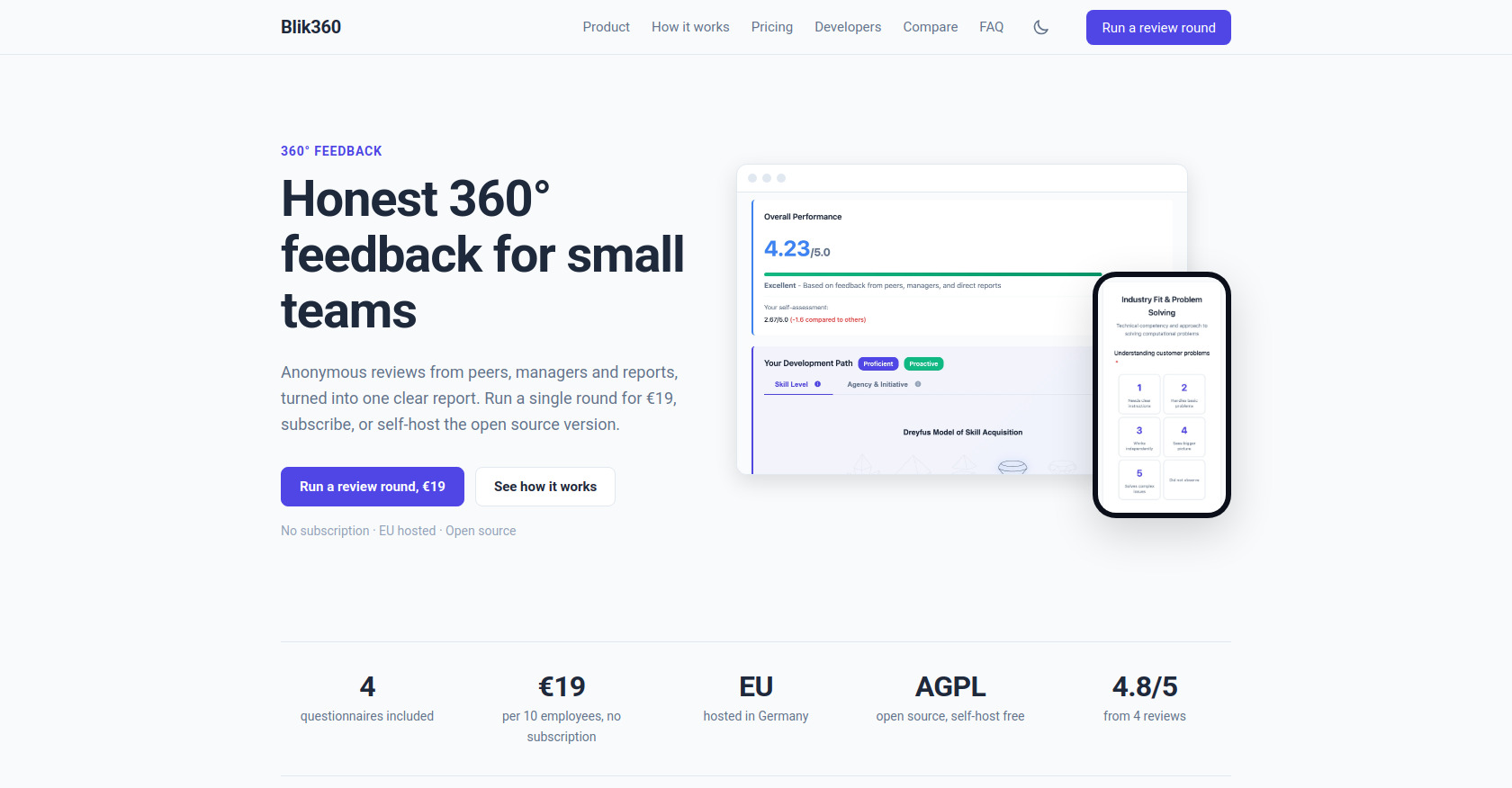
Landing page for Blik360, an open-source 360-degree feedback platform designed for small teams. It allows anonymous reviews from peers, managers, and direct reports, consolidating results into a single report per person. The page outlines key features: four pre-built questionnaires (Professional Skills, Software Engineering, Manager, and a quick 12-question version), Dreyfus model competency mapping, five levels of agency framework, and a performance matrix. Three pricing tiers are presented: free self-hosted (AGPL-3.0), one-time €19 per 10 employees for a single hosted round, and monthly subscriptions (€49 for up to 50 employees, €199 for up to 200). The project is created by Thijs de Zoete (CEO at Tinify) and emphasizes EU hosting (Hetzner, Germany), GDPR tooling, token-based anonymity, Docker deployment, and REST API access. A pricing comparison against Lattice, Culture Amp, and 15Five is included, highlighting Blik's lower cost and narrower scope.
Target audience
Small to medium-sized teams (up to 200 employees) looking for an affordable, transparent 360-degree feedback system. Also targets HR managers, engineering leads, and people operations professionals who want anonymous peer reviews without enterprise-level complexity or per-seat pricing. Developers and tech-savvy organizations interested in self-hosting an open-source AGPL-3.0 solution.
Key features
- Four research-backed questionnaires tailored to different roles (Professional Skills, Software Engineering, Manager, and a quick 12-question 360 feedback)
- Dreyfus Model skill mapping (Novice to Expert) and Five Levels of Agency for concrete growth stages
- Token-based anonymous reviews – no user accounts needed for reviewers, works on mobile via private email links
- One-page report per person with competency scores per reviewer group, self vs. others gap analysis, strengths, development areas, and written comments
- Flat pricing with no per-seat fees – self-host free (AGPL-3.0), one-time €19/10 employees for single round, or monthly subscriptions from €49 for up to 50 employees
- EU-hosted (Hetzner, Germany) with daily backups on the managed plan
- GDPR support tools – full JSON organization export, data deletion, 30-day retention after cancellation
- Docker-based self-hosting with a single
docker compose upcommand and setup wizard - REST API and HMAC-signed webhooks for integration, plus full plain-JSON data export
- Customizable questionnaires with Likert scales, multiple choice, free text, and mobile-friendly segments
- Automatic reminder emails for reviewers who haven't responded
Pain points
- Prohibitively expensive enterprise 360 tools – Lattice, Culture Amp, and 15Five charge per-seat fees with annual minimums (e.g., Lattice $6,000–19,200/year for 50 people), while Blik offers €19 one-time or €588/year
- Complexity and bloat of traditional performance management suites – alternatives include modules for OKRs, compensation, engagement surveys that small teams don't need
- No simple pay-per-round model from competitors – small teams doing 1–2 review cycles per year can't justify an ongoing subscription
- Privacy and data sovereignty concerns – especially for EU companies needing GDPR-compliant tools with local hosting
- Reviewer friction – many tools require reviewers to create accounts or install apps; Blik uses anonymous token links sent by email, no signup required
- Vague performance ratings – traditional scales (1–5) don't provide actionable growth paths; Dreyfus model gives concrete next stages
- Difficult self-hosting – many open-source tools lack Docker-based deployment with setup wizards
Usage instructions
- Choose your plan: Self-host for free via GitHub (Docker Compose + PostgreSQL), buy a one-time Single Round (€19/10 employees), or subscribe to EU Hosted (€49/month for up to 50 employees). 2. Set up a review round: Add the person being reviewed, pick a questionnaire (or create your own), and list who should give feedback (peers, managers, reports). 3. Reviewers respond: Each reviewer receives a private link by email – no account, no app, works on a phone. Automatic reminders are sent. 4. Read the report: View scores per competency grouped by reviewer type, self vs. others comparison with gap callouts, Dreyfus skill level, agency level, performance matrix quadrant, strengths, development areas, and written comments. Share the report with the person or keep it private for the conversation.